
Vitamin & Mineral Stack
Vitamin D and Magnesium: A Week in the Routine
Marcus Chen · 18 February 2026 · 9 min read
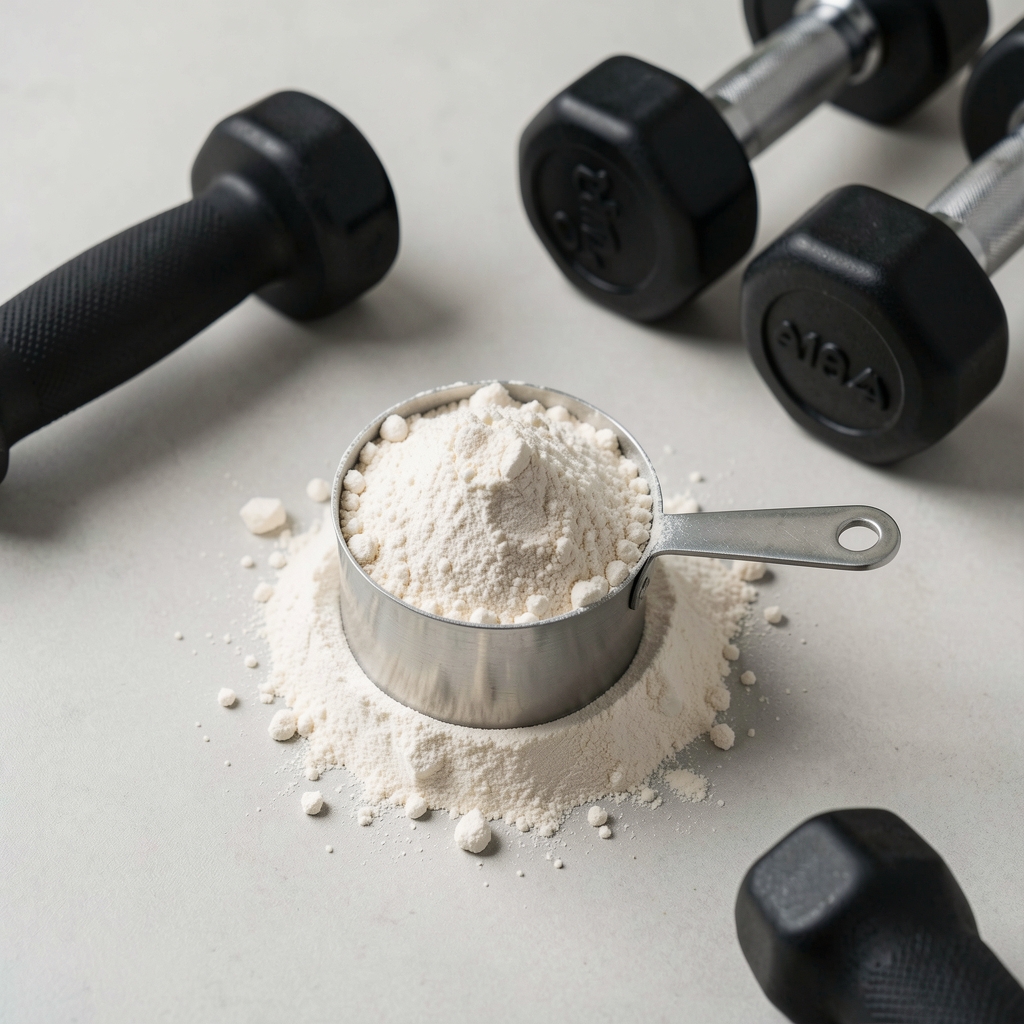
Creatine occupies an unusual position in the landscape of everyday supplementation for active men. It is, by the measure of published nutritional research, one of the most studied compounds in the supplement domain. Yet the popular understanding of what creatine does — and more importantly, what it does not do — remains imprecise. This editorial review assembles observations from the available literature alongside the journal's own editorial perspective on how creatine fits within a non-elite, everyday training context.

Everyday training equipment alongside a creatine supplement container — the context this review addresses.
A careful reading of the published nutritional research on creatine monohydrate reveals a pattern that is more modest than popular coverage suggests. Creatine supports physical output over time in resistance training routines — specifically, it contributes to the resynthesis of adenosine triphosphate (ATP) during short, high-intensity efforts. This is the consistent finding across a broad body of peer-reviewed work spanning more than three decades.
What this means in practical terms for the everyday active man is nuanced. The benefit is most clearly observed in activities that rely on repeated short bursts of effort: compound resistance sets, sprint intervals, high-intensity circuit work. For men engaged in lower-intensity endurance activities as their primary form of exercise, the contribution of creatine supplementation to daily performance is less clearly documented.
A second consideration, less frequently raised in popular writing, is that creatine is naturally present in the diets of men who eat red meat and fish regularly. Men with higher baseline dietary intake of these foods may show smaller observed responses to supplementation than men whose diet is primarily plant-based or lower in animal proteins. The editorial implication is straightforward: the baseline nutritional context matters. Creatine supplementation as an addition to an already varied protein-rich diet operates differently from creatine supplementation used to address a nutritional gap.
"The benefit of creatine is most clearly observed in activities that rely on repeated short bursts of effort — not as a general daily enhancement."
Editorial observation — Oravel Journal, March 2026
The so-called loading phase — typically described as five to seven days of higher-dose intake before reducing to a maintenance amount — has become a default recommendation in many popular supplement guides. It is worth examining this more carefully than the popular guides usually do.
Published research indicates that the loading protocol does accelerate the time to reach muscle saturation of creatine stores. However, the same research also documents that consistent lower-dose intake over three to four weeks achieves comparable saturation, albeit more gradually. For the non-competitive, everyday active man whose training schedule runs across months and years rather than a specific preparation window, the loading phase is a tool for a different context.
This does not mean loading is inadvisable. It means the choice between loading and a gradual approach should be informed by the actual context: an athlete preparing for a competition where a short window matters is in a different position from someone building long-term nutritional habits around their four-times-per-week gym routine.
For the journal's editorial purposes, the everyday-man context argues for the gradual approach. It is quieter, structurally simpler, and does not require the kind of precise tracking that the loading protocol implies. Consistency over time, rather than initial intensity of intake, is the pattern we observe most reliably in men whose supplement habits have persisted across years rather than weeks.

The post-session window: creatine and protein intake timing observed across six weeks of the journal's field notes.
One of the more practically useful questions for active men considering creatine is where it sits within a broader daily supplement stack. The published literature offers relatively clear guidance on this: creatine does not appear to interact adversely with the common supplementation companions — protein powder, vitamin D, magnesium, omega-3. These four, together with creatine, form what the journal considers the core of a well-considered everyday stack for active men.
Timing is a matter of ongoing discussion in the nutritional research literature. Some published work suggests post-exercise intake may produce marginally better outcomes than pre-exercise intake; other work shows no significant difference. The editorial position of this journal is that timing is secondary to consistency. A creatine intake that occurs reliably at the same point each day — whether that is morning with breakfast, post-session with a protein source, or evening — is more valuable than one that optimises for a narrow window but is harder to maintain.
Hydration is the one practical consideration that the evidence does consistently associate with creatine use. Creatine draws water into muscle cells as part of its physiological action. Men supplementing with creatine who do not maintain adequate daily hydration may notice dryness, slight cramping, or reduced comfort during exercise. The simple guidance here is to maintain the same daily water intake standard that active men should maintain regardless of supplementation — approximately two to three litres, adjusted for session intensity and climate. Indonesia's climate makes this particularly relevant: the heat and humidity of Jakarta's working environment increases baseline hydration requirements relative to temperate contexts.
An editorial review of creatine is incomplete without addressing what the published research explicitly does not support. These boundaries are important: the supplement domain is marked by a tendency to expand claims beyond what the evidence actually sustains.
The published nutritional research does not support the use of creatine as a weight management supplement. Any change in body composition observed with creatine is attributable to water retention within muscle cells and to the downstream effects of sustained training output — not to any fat-reduction property. Men selecting creatine in the expectation of body composition change outside of a structured resistance training context are working against the grain of the evidence.
The research also does not establish creatine as relevant to cognitive performance in healthy, non-sleep-deprived men within normal supplementation ranges. This is a claim that has appeared with increasing frequency in popular wellness content. The evidence on creatine and cognitive function is preliminary, context-specific, and does not support the general claim that creatine supports daily focus or mental output in the way B vitamins and iron are studied for.
This journal does not repeat claims that the evidence does not sustain. The role of creatine in everyday active men's nutrition is physical output support through resistance training over time. That is the role. It is a useful one.
We recommend speaking with a qualified wellness or nutrition professional before introducing any new supplement to your daily routine, particularly if you have specific dietary requirements or are new to structured supplementation.

Marcus Chen is the primary contributing writer and editor of Oravel Journal, based in Jakarta. His editorial focus covers men's nutritional awareness, supplement routine documentation, and the intersection of active lifestyle habits with evidence-informed supplementation.
More from Marcus